Showing posts with label Quantitative Ability. Show all posts

Monday, 3 October 2016

MCQs Math

mcqs_math, nts_past_paper
MCQs Math

Quantitative Ability multiple choice questions (MCQs) Post-10. The following Quantitative Ability questions are from percentage.

    Question 4

    In a school of 820 students, 55% are boys. The number of girls and the number of boys are:


    Question 4: The correct answer is Answer 4: 451 boys, 369 girls.

    Name

    E-mail *

    Error Description *

    Question 5

    Jafer drew a square. He then erased it and drew a second square whose sides were 3 times the sides of the first square. By what percent was the area of the square increased ?


    Question 5: The correct answer is Answer 2: 800%.

    Name

    E-mail *

    Error Description *

    Question 6

    A team has won 60 percent of the 20 games for all this season. If the team plays a total 50 games all season and wins 80 percent of the remaining games, how many games will the team win for the entire season ?


    Question 6: The correct answer is Answer 1: 36.

    Name

    E-mail *

    Error Description *

    Question 7

    Local telephone calls increased in price from 25Pa to 30Pa. What percentage increase was this ?


    Question 7: The correct answer is Answer 4: 20%.

    Name

    E-mail *

    Error Description *

    Question 8

    A worker pays Rs. 350 tax per month, which is 15% of his income. What is his income ?


    Question 8: The correct answer is Answer 3: 2333.30.

    Name

    E-mail *

    Error Description *

    Question 10

    Baber gave 15% of his baseball cards to Laeeq and 20% to Sarfraz. If he still had 520 cards, how many did he have originally?


    Question 10: The correct answer is Answer 1: 800.

    Name

    E-mail *

    Error Description *

Sunday, 2 October 2016

Math MCQs

math_mcqs, percentage
Math MCQs

Quantitative Ability multiple choice questions (MCQs) Post-9. The following Quantitative Ability questions are from percentage.

    Question 1

    If the base of a rectangle is increased by 40% and its altitude is decreased by 20%, then its area is:


    Question 1: The correct answer is Answer 2: increased by 12%.

    Name

    E-mail *

    Error Description *

    Question 7

    If 35 students took an exam and 13 of them failed, what percent of them passed ?


    Question 7: The correct answer is Answer 2: 63% approx.

    Name

    E-mail *

    Error Description *

    Question 8

    There are twice as many boys as girls in an economics class. If 20% of the boys and 35% of the girls have already handed over their result cards, what percent of the students have not yet handed over their cards ?


    Question 8: The correct answer is Answer 1: 75.

    Name

    E-mail *

    Error Description *

    Question 9

    A dealer bought an ornamental jar for Rs. 7,000 and after some days sold it for Rs. 21,000. By what percent did the value of jar increase ?


    Question 9: The correct answer is Answer 2: 200.

    Name

    E-mail *

    Error Description *

    Question 10

    On a test consisting of 60 problems, Sonia solved 75% of first 40 problems correctly. What percent of the other 20 questions does she need to solve correctly for her grade on the entire exam to be 90% ?


    Question 10: The correct answer is Answer 4: cannot achieve 90%.

    Name

    E-mail *

    Error Description *

Saturday, 1 October 2016

Quiz Math

quiz_math
Quiz Math

Quantitative Ability multiple choice questions (MCQs) Post-8. The following Quantitative Ability questions are from fractions and decimals.

    Question 2

    Ali purchased some goldfish. During the first week, 1/5 of them died, and during the second week, 3/8 of those still alive at the end of the first week died. What is the fraction of the original goldfish still alive after two weeks?


    Question 2: The correct answer is Answer 1: 1/2.

    Name

    E-mail *

    Error Description *

Geometry

geometry
Geometry

Lines And Angles

  • An angle is formed at the intersection of two line segments, rays or lines. The point of intersection is called the vertex. Angles are measured in degrees.
  • Angles are classified according to their degree measures.
  • An acute angle measures less than 90o
  • A right angle measures 90o
  • An obtuse angle measures more than 90o but less than 180o
  • A straight angle measures 180o
  • If two or more angles combine together to form a straight angle, the sum of their measures is 180o.
    ao + bo + co + do = 180o
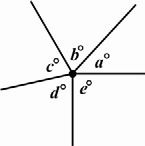
  • The sum of all the measures of all the angles around a point is 360o
    ao + bo + co + do + eo = 360o
  • When two lines intersect, four angles are formed, two angles in each pair of opposite angles are called vertical angles. Vertical angles, formed by the intersection of two lines, have equal measures.
    ao = co, bo = do
  • If one of the angles formed by the intersection of two lines is a right angle, then all four angles are right angles. Such lines are called perpendicular lines
    ao = bo = co = 90o
  • In the figure below a line l divides the angle in two equal parts. This line is said to bisect the angle. The other line k bisects another line into two equal parts. This line is said to bisect a line.
  • Two lines are said to be parallel, if they never intersect each other. However, if a third line, called a transversal, intersects a pair of parallel lines, eight angles are formed. And the relationship among theses angles is shown in the following diagram.
    • All four acute angles are equal ao = co = eo = go
    • All four obtuse angles are equal bo = do = fo = ho
    • The sum of any pair of acute and obtuse angle is 180°, e.g. ao + do =180o,
      do + eo =180o, bo + go = 180° etc.

Triangles

  • In any triangle, the sum of the measures of the three angles is 180o.
    xo + yo + zo = 180o
  • In any triangle:
    • The longest side of triangle is opposite the largest angle.
    • The shortest side is opposite the smallest angle.
    • Sides with the same length are opposite the angles with the same measure.
  • Triangles are classified into three different kinds with respect to the lengths of sides.
    • Scalene: in which all three sides are of different lengths.
    • Isosceles: in which two of the sides of triangle are equal in length, the third is different.
    • Equilateral: in which all three sides are equal in length.
  • Triangles are also classified with respect to the angles.
    • Acute triangle: in which all three angles are acute.
    • Obtuse triangle: in which one angle is obtuse and two are acute.
    • Right triangle: This has one right and two acute angles.
  • In a right triangle, the opposite to the right angle is known as hypotenuse and is the longest side. The other two sides are called legs.
  • In any right triangle, the sum of the measures of the two acute angles is 90o.
  • By Pythagorean Theorem, the sum of squares of the lengths of legs of a right triangle is always equal to the square of length of hypotenuse.
    a2 + b2 = c2
  • In any triangle, the sum of any two sides is always greater than the third one. And the difference of any two sides is always less than the third one.
    a + b > c and a - b < c
  • The perimeter of a triangle is calculated by adding the lengths of all the sides of that triangle.
    perimeter = a + b + c
  • The area of a triangle is calculated by the formula: area = (1/2)bh where b is the base of the triangle and h is the height of the triangle.
    • Any side of triangle can be taken as the base.
    • Height is the altitude (perpendicular) drawn to the base from its opposite vertex.
    • In a right triangle any leg could be taken as the base, the other will be the altitude.

Quadrilateral and other Polygons

  • A polygon is a closed geometric figure, made up of line segments. The line segments are called sides and the end points of lines are called vertices (plural of vertex). Lines, inside the polygon, drawn from one vertex to the other, are called diagonals.
  • The sum of the measures of the n angles in a polygon with n sides is
    always (n − 2)×180o.
  • In any quadrilateral, the sum of the measures of the four angles is 360o.
  • A regular polygon is a polygon in which all of the sides are of the same length. In any regular polygon, the measure of each interior angle is
    ((n - 2) x 180o)/n and the measure of each exterior angle is 360o/n.
  • A parallelogram is a special quadrilateral, in which both pairs of opposite sides are parallel. The Following are some properties of parallelogram.
    • Lengths of opposite sides are equal. AB = CD and AD = BC
    • Measures of opposi te angles are equal. ao = co and bo = do
    • Consecutive angles add up to 180o. ao + bo =180o , bo + co =180o etc.
    • The two diagonals bisect each other. AE = EC and BE = ED
    • A diagonal divides the parallelogram into two triangles that are congruent.
  • A rectangle is a parallelogram in which all four angles are right angles. It has all the properties of a parallelogram. In addition it has the following properties:
    • The measure of each angle in a rectangle is 90o.
    • The diagonals of a rectangle are equal in length.
  • A square is a rectangle that has the following additional properties:
    • A square has all its sides equal in length.
    • In a square, diagonals are perpendicular to each other.
  • To calculate the area, the following formulas are required:
    • For a parallelogram, Area = bh , where b is the base and h is the height.
    • For a rectangle, Area = lw, where l is the length and w is the width.
    • For a square, Area = s2 , where s is the side of the square.
  • Perimeter for any polygon is the sum of lengths, of all its sides.

Circles

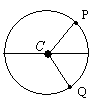
  • A circle consists of all the points that are the same distance from one fixed point called the center. That distance is called the radius of a circle. The word radius is also used to represent any of the line segments joining the center and a point on the circle. The plural of radius is radii.
  • Any triangle, such as CED in the figure, formed by connecting the end points of two radii, is an isosceles.
  • A line segment, such as ED in the diagram above, both of whose end points are on a circle is called a chord.
  • A chord that passes through the center of the circle is called the diameter of the circle. The length of the diameter is always double the radius of the circle. The diameter is the longest cord that can be drawn in a circle.
  • The total length around a circle is known as the circumference of the circle.
  • The ratio of the circumference to the diameter is always the same for any circle. This ratio is denoted by the symbol π (pronounced as pi).
  • π = C/d ⇒ C=πd ⇒ C= 2πr where C is the circumference, d is the diameter and r is the radius of the circle.
  • Value of π is approximately 3.14
  • An arc consists of two points in a circle and all the points between them. E.g. PQ is an arc in the diagram.
  • An angle whose vertex is at the center of the circle is called the central angle. ∠PCQ in the diagram above is a central angle.
  • The degree measure of a complete circle is 360o.
  • The degree measure of an arc is the measure of the central angle that intercepts it. E.g. the degree measure of PQ is equal to the measure of ∠PCQ in the diagram above.
  • If x is the degree measure of an arc, its length can be calculated as (x/360)C where C is the circumference.
  • The area of a circle can be calculated as πr2.
  • The area of a sector formed by the arc and two radii can be calculated as (x/360)A, where A is the area of a circle.

Friday, 30 September 2016

Test Math

test_math
Test Math

Quantitative Ability multiple choice questions (MCQs) Post-7. The following Quantitative Ability questions are from fractions and decimals.

    Question 1

    If 5/x, 8/x and 13/x are all in lowest terms. Then how many integers, x, between 30 and 40?


    Question 1: The correct answer is Answer 4: None of these.

    Name

    E-mail *

    Error Description *

    Question 6

    There are 20 boys in a class. Five of them are left-handed. What fraction of the class is left handed?


    Question 6: The correct answer is Answer 3: 1/4.

    Name

    E-mail *

    Error Description *

    Question 7

    A chemical solution contains 8% of acid. If there is 15ml of acid, what is the volume of the solution?


    Question 7: The correct answer is Answer 2: 187.5 mL.

    Name

    E-mail *

    Error Description *

    Question 9

    A village has 5860 voters, of whom 7% usually forget to vote. In order to win an election, a candidate must gain at least 50% of the remaining votes. How many votes does he need in order to win?


    Question 9: The correct answer is Answer 1: 2725.

    Name

    E-mail *

    Error Description *